There is a quiet shift happening in classrooms and bedrooms across India. High school students are no longer waiting to reach college before engaging with real data. They are running experiments, cleaning datasets, and drawing conclusions from numbers right now using Python. And for students who want to get ahead, understanding Python basics for beginners online in India is becoming less of a bonus and more of a baseline expectation.
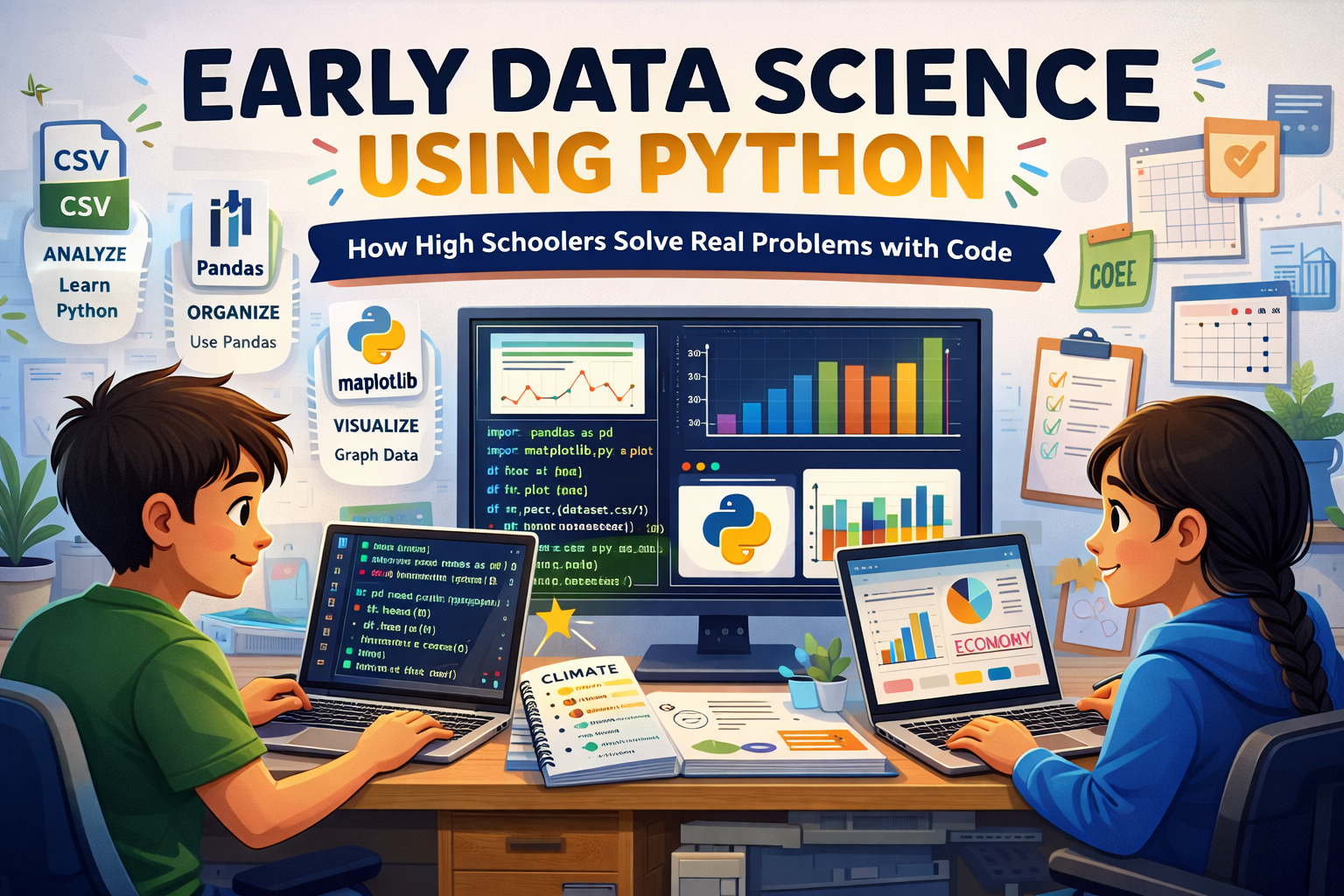
Science fair projects used to mean poster boards and baking soda volcanoes. Today, a student in Class 11 from Pune or Hyderabad can analyze climate data, visualize trends in public health records, or build a model that predicts exam performance using nothing more than a laptop and a few freely available Python libraries. The tools are accessible. The real question is whether students know how to use them.
This article walks through why Python has become the go-to language for high school science projects in India, what kinds of projects are actually doable at this level, and how students can build the skills to get there without feeling overwhelmed from day one.
Why Python Works So Well for High School Data Projects

It was no coincidence that Python became the most widely used programming language in the world. It includes a number of features that make it truly perfect for novices who wish to complete tasks fast, especially when it comes to data work.
The syntax is close to plain English. A student reading a Python script for the first time can often guess what it does, even without prior coding experience. That low barrier to entry means students spend less time fighting the language and more time thinking about the actual problem they are trying to solve.
Beyond the syntax, Python has a library ecosystem that is unmatched for data science work. Pandas handles spreadsheet-style data. Matplotlib and Seaborn turn numbers into charts. NumPy makes mathematical operations fast. These are the same tools used by data scientists at Google, ISRO, and hospitals across India. High school students using them are learning with professional-grade equipment.
A 2023 Stack Overflow Developer Survey found that Python was the most widely used programming language for the seventh consecutive year, with data science ranking as one of its top applications. For a student choosing where to invest their learning time, that is a significant signal.
What High School Science Projects Actually Look Like with Python
The projects that impress teachers, science fair judges, and college admissions panels share a common trait: they answer a real question with real data. Python makes that possible at the high school level in ways that were simply not accessible to previous generations of students.
Environmental Data Analysis
A student curious about air quality in their city can download publicly available AQI data from government portals, clean it using Pandas, and create visualizations that show pollution patterns across seasons or neighborhoods. This is a complete research project with a real dataset, a genuine question, and findings that mean something.
Public Health Trends
Students interested in medicine or public policy can work with anonymized health datasets to explore questions like how vaccination rates correlate with disease incidence or how hospital density varies across Indian states. These projects develop critical thinking about data quality, correlation versus causation, and responsible use of sensitive information.
Economics and Local Market Data
Students can scrape or download local market price data, petrol prices, or crop yield statistics and analyze trends over time. A student in an agricultural region might explore how monsoon rainfall has affected wheat prices across a five-year window. This kind of project connects coding skills to community-level relevance.
The Skills Students Build Along the Way
The visible output of a Python data project is a chart or a finding. But the invisible output is a set of skills that carry far beyond the project itself.
• Data literacy: Understanding what a dataset contains, what its limitations are, and what questions it can and cannot answer.
• Critical thinking: Learning to question whether a pattern in the data reflects reality or is an artifact of how the data was collected.
• Problem decomposition: Breaking a large question into smaller steps that can be coded and tested one at a time.
• Communication: Translating findings into visualizations and written explanations that non-technical audiences can understand.
• Persistence: Debugging code and cleaning messy data are exercises in patience and methodical thinking that no other school activity quite replicates.
These are skills that universities and employers consistently say they want and consistently say are hard to find. A student who arrives at a college interview having completed a genuine data science project has a concrete, specific story to tell about each of them.
Starting with the Right Foundation: What Beginners Need First
Before any student can run a data science project, they need to be comfortable with the basics. Jumping straight into Pandas without understanding variables, loops, and functions is a reliable way to get stuck and give up. This is why the right entry point matters enormously.
Students who explore Python basics for beginners online in India through structured courses learn these foundations in a logical sequence. Variables and data types first. Then conditionals and loops. Then, functions and how to organize code cleanly. Then, once those feel comfortable, data libraries become much less intimidating because the underlying logic is already familiar.
The foundational concepts also connect directly to science project work. Understanding how a loop works is the same understanding you need to iterate over rows in a dataset. Knowing how to write a function prepares you to create reusable code for data cleaning. The path from beginner Python to real data science is shorter than most students expect when the foundations are solid.
Core Python Concepts Every Aspiring Data Student Needs
• Variables, data types, and basic arithmetic operations.
• Lists, dictionaries, and how to manipulate collections of data.
• Loops and conditionals for processing data row by row.
• Functions for keeping code organized and reusable.
• File reading and writing for loading real datasets into a program.
How Structured Courses Help Students Move Faster
Self-directed learning through YouTube tutorials and free resources is entirely possible. But the students who move fastest and build the most complete skill sets tend to be those who learn through structured programs with a clear progression, regular feedback, and a community of peers working on similar things.
Quality coding courses for students ages 12 to 18 designed around Python and data science give learners a roadmap. Each module builds on the last. Assignments are designed to produce something tangible. And instructors can catch the subtle misunderstandings that self-learners often carry for months without realizing anything is wrong.
There is also a social dimension that matters more than people realize. A student who knows that three classmates are also struggling with the same error message is far more likely to push through than one who is stuck alone at 10 PM with no one to ask. Online communities built around structured courses recreate some of that collaborative energy.
For students specifically interested in Python for data science for teens, the best courses balance conceptual understanding with hands-on project work from the very beginning. Theory without application fades quickly. Projects without explanation leave gaps that cause problems later. The best programs give both.
Building on Basic Programming Concepts for Real Project Work
One thing that sometimes gets lost in the excitement around data science tools is how much the fundamentals matter. The students who produce the most impressive high school computer science projects are rarely the ones who learned the most libraries. They are the ones who understood the underlying logic so well that they could apply it to any new tool they encountered.
Investing time in basic programming concepts for students in India before diving into specialized libraries pays compound returns. A student who genuinely understands how data structures work will pick up Pandas in a week. A student who jumped straight to Pandas without that foundation will find themselves copying code they do not understand and unable to fix it when something breaks.
This is why the most effective learning paths are sequential rather than shortcut-driven. Spend four to six weeks building a real command of core Python. Then spend another four to six weeks applying those skills to data problems. By the end of three months, a motivated student can produce project work that stands out at the school level and beyond.
A Simple Three-Month Learning Path for High Schoolers
• Month 1: Core Python. Variables, loops, conditionals, functions, and basic file handling. Build at least two small projects, like a quiz app or a number analyzer.
• Month 2: Data libraries. Introduction to Pandas and Matplotlib. Load a real dataset, clean it, and produce three types of charts.
• Month 3: Full project. Choose a genuine question, find a real dataset, conduct an analysis, and write up findings. This becomes a portfolio piece.
What Parents and Educators Can Do to Support This Learning
Students do not learn data science in a vacuum. Parents and teachers play a significant role in whether a student has the environment and encouragement to pursue this kind of project work.
For parents, the most useful thing is removing friction. Making sure the student has a reliable device, a stable internet connection, and uninterrupted time to work on projects matters more than any particular course or resource. Showing genuine interest in what the student is building, even without understanding the technical details, makes a measurable difference in how long learners persist.
For educators, integrating basic programming concepts for students in India into existing science and math curricula is more achievable than it might seem. A statistics lesson where students collect real data and visualize it in Python is more engaging and more educational than the same lesson done on paper. The technology does not replace the pedagogy. It amplifies it.
And for students exploring coding courses for students age 12 to 18, the single most important thing is to start before you feel ready. Readiness comes from doing, not from waiting. The students who make the most progress are rarely the most naturally gifted. They are the ones who started earliest and stayed curious longest.
Conclusion
Data science is not a subject reserved for college students or working professionals. It is a set of skills that high schoolers across India are building right now, through real projects, real datasets, and real tools. And Python basics for beginners online in India is the most practical entry point into that world.
If you are ready to begin or ready to support a student who is, Rise With Tech offers structured, project-centered learning paths designed specifically for high school students in India who want to build real skills and real portfolios.
1. What is the best age to start Python for data science?
Ages 13–15 are ideal for starting data science. Younger students can begin with basic Python first.
2. Do students need strong maths for data science?
Basic school-level maths is enough to start. Advanced maths can be learned later.
3. Where can students find free datasets in India?
Platforms like Data.gov.in and Kaggle offer free datasets. They are easy to use for projects.
4. How long does it take to build a data project?
Around 2–3 months with regular practice. Consistent learning speeds up progress.
5. How do basic programming concepts help in data science?
They form the foundation for tools like Pandas. Strong basics make learning easier and faster.