Introduction:
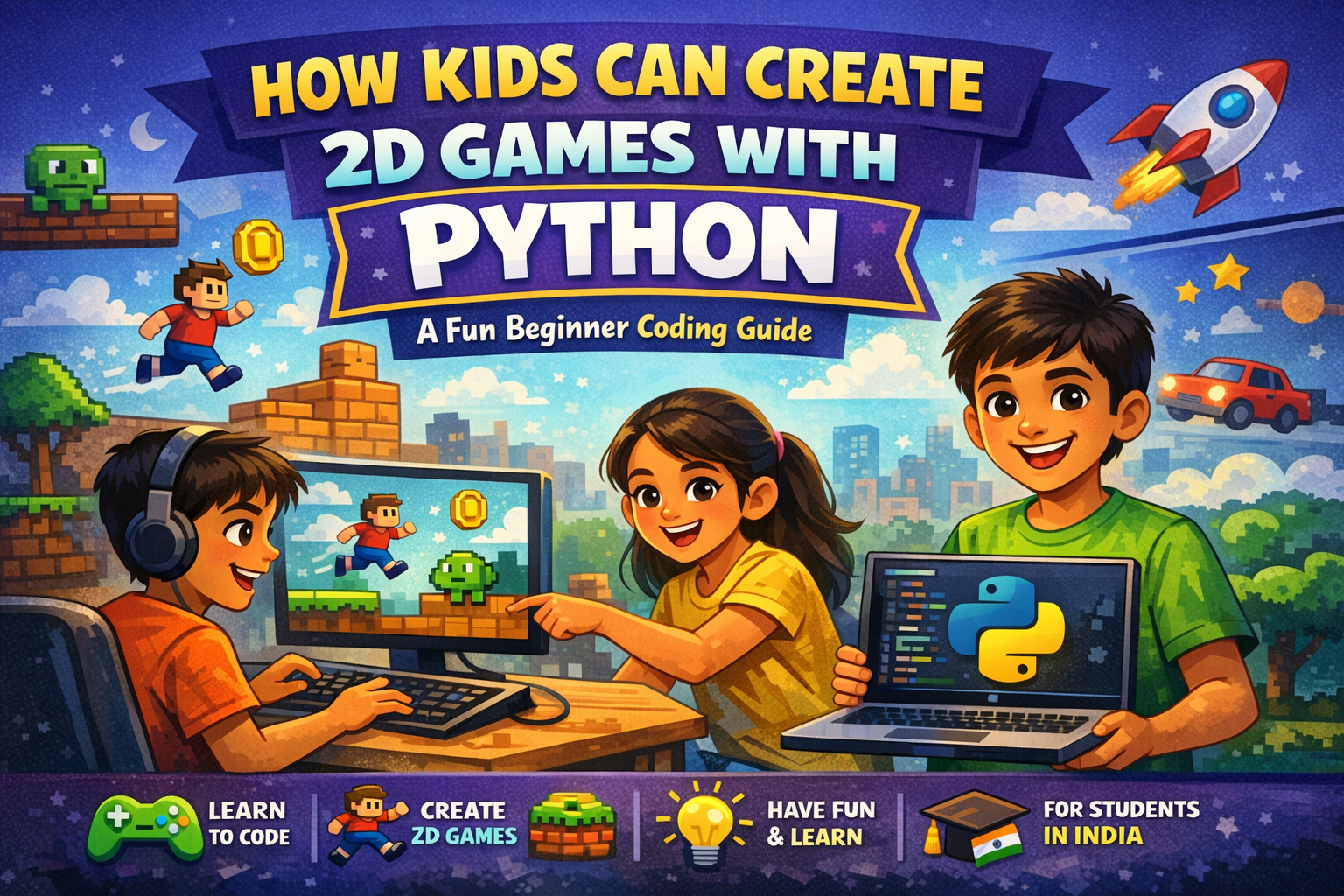
With the current digital era, code breaks the world code faster, and knowing how to read and write is becoming as important as knowing how to code. To the children in India, coding is not only about learning to interact with technology, but also about learning to be creative, learning to solve problems, and learning to have confidence. Python is a great language to use to write 2D games, which is one of the most exciting aspects of beginning coding. Your child may be interested in game development, and this guide will demonstrate that it is not hard or unpleasant to start something.
Whether you’re looking to learn python online for students in India or simply introduce your child to programming, this beginner-friendly guide will help you take the first step.
Why Python is Perfect for Kids
Persuading oneself that Python is among the best programming languages as a beginner language is quite justifiable. It can be simply written, and therefore, children can concentrate on learning logic and not on the complex code.
And this is the reason why Python is such a good language to teach young people:
● Easy to read and write, Python resembles the English language and is easy to work with.
● Flexible: Children have the opportunity to create games, applications, animations, and others.
● High Community Support: There are a lot of resources and tutorials.
● Fun Libraries: Game developers are inspired to use libraries such as Pygame.
For students who want to explore python programming for beginners in India, Python offers the perfect starting point.
What is a 2D Game?
A 2D game is a video game that is played in a 2-dimensional setting. The characters, the backgrounds, and objects move on the X and Y axes.
Extensively used 2D games are:
● Platform games (such as jumping characters)
● Puzzle games
● Simple racing games
● Arcade-style games
Making games of this kind helps kids to know the fundamentals of programming in a disarming manner.
Tools Kids Need to Get Started
The children will be required to have a few simple tools before going into coding:
1. Python Installed
Python is also downloaded via the official website and installed.
2. Code Editor
Simple editors such as IDLE (which is included with Python) or VS Code are excellent.
3. Pygame Library
Pygame is a popular Python library that is used to create games. It has control over graphics, sound, and user inputs.
To install Pygame, just type the following:
pip install pygame
In India, a number of online coding courses for children and adolescents have included informative setup sessions to simplify this task among beginner learners.
Basic Concepts Kids Will Learn
Before building a game, kids should understand a few coding fundamentals for beginners:
Variables
Administered to store information such as scores, the position of the player, or speed.
Loops
Support repeat tasks, like updating the screen of the game incessantly.
Conditionals
Have decisions made by the program (e.g., when the player crashes against a wall, halt the play).
Functions
Categorize codes into resets.
All of programming is made up of these fundamental concepts.
Best Beginner-Friendly Game Ideas for Kids
Starting with simple game ideas helps kids stay motivated and confident. Instead of jumping into complex projects, beginners can try creating easy 2D games like a bouncing ball game, a basic car racing game, or a simple catch-the-object game. These projects introduce core concepts such as movement, collision detection, and scoring systems without overwhelming the learner. As kids complete these small projects, they build a strong foundation and gradually gain the confidence to experiment with more advanced game designs.
Making the Game More Fun
When children learn the fundamentals, it will be possible to add some creative elements to the game:
Add Enemies
Form objects that move towards a player.
Add Score System
Give a reward to the player who survived or picked up some items.
Add Sound Effects
Interactivity - Use the sound capabilities of Pygame to make the game interactive.
Add Levels
Difficulty should be added as the game is played.
At this point, creativity is used the most; children can transform the simplest things into exciting games.
How Kids Can Improve Their Python Skills Faster
Consistency is key when it comes to learning coding. Kids should practice regularly, even if it’s just 20–30 minutes a day. Encouraging them to modify their existing games—like changing colours, adding new levels, or introducing sound effects—can significantly improve their understanding. Participating in coding challenges, watching beginner-friendly tutorials, and collaborating with peers also accelerates learning. Structured platforms like Rise With Tech provide guided practice and real-time feedback, helping kids learn more efficiently and avoid common mistakes.
Good Results of Game Development for Kids
There is nothing more fun than learning how to build games, except that it is also a good life skill:
Boosts Creativity
Children come up with characters, backgrounds, and plots.
Improves Logical Thinking
They get to know how to divide problems into actions.
Encourages Persistence
Patience and resilience in debugging.
Builds Confidence
The feeling of completing a game makes one feel strong.
Coded programmes such as the ones provided by this site aim at developing this set of skills through guided learning systems.
Why Early Coding Skills Give Kids a Competitive Edge
In today’s technology-driven world, learning coding at an early age gives kids a significant advantage. It not only prepares them for future careers in fields like software development, artificial intelligence, and game design but also enhances critical thinking and problem-solving abilities. Coding teaches kids how to approach challenges logically and develop solutions independently. By starting early with tools like Python, children become more adaptable and confident in using technology, setting them up for long-term academic and professional success.
Learning Python the Smart Way
While self-learning is possible, guided learning can accelerate progress. Many parents in India are now choosing structured programs to help their kids succeed.
Why choose online coding classes for kids and teens in India?
● Live guidance from expert mentors
● Interactive sessions and real projects
● Peer learning and collaboration
● Step-by-step curriculum
If your child wants to learn python online for students in India, enrolling in a structured course can make the journey smoother and more enjoyable.
Parenting Advice to Help Children
You do not need any technical knowledge to help your child learn how to code. These are the ways in which you can help them:
● Stimulate experimentation - allow them to experiment.
● Congratulate minor (such as bug-fixing) accomplishments.
● Ensure a distraction-free learning atmosphere.
● Send them to reputable schemes such as Rise With Tech.
Having a conducive environment is important in ensuring that kids are motivated.
Common Mistakes Beginners Should Avoid
Even basic coding trips may be accompanied by challenges. These are some of the pitfalls that one should avoid making:
Skipping Basics
Before a person goes into sophisticated games, it is important to know the basics.
Getting Frustrated Easily
Mistakes are ventures of learning- help kids to be patient.
Copy-Pasting Code
It is more preferable to learn code as opposed to merely copying it.
Not Practicing Enough
Practice is a way of gaining confidence and mastery.
Future Opportunities in Coding
Learning Python at a young age opens doors to numerous future opportunities:
● Game development
● App development
● Artificial Intelligence
● Data science
Starting early gives kids a strong foundation for future careers in technology.
With such platforms, students can gradually move from beginner concepts to advanced skills in a structured way.
Ready to Start Coding?
Getting started with Python game development is easier than ever. With the right guidance, simple tools, and regular practice, kids can quickly turn their ideas into fun 2D games. This platform makes this journey even smoother by offering structured lessons and hands-on projects designed especially for young learners.
Conclusion
One of the most appealing ways for kids to begin their coding career is by making 2D games using Python. It is creative, logical, and fun, which makes the learning process effective and entertaining.
To find opportunities in providing children with an acquaintance with the world of programming, prioritizing the basics of coding as an entry-level language and putting their children through online coding courses specifically designed to teach this language to children and teenagers in India might make a difference.
In case your child is already willing to dive into the world of coding, it is high time that you taught him or her Python online, and students in India could easily acquire their first game. With expert-led programs from Rise With Tech, kids receive the right guidance, hands-on experience, and encouragement to grow their skills step by step.
Through proper roles and daily rehearsals, the modern-day generation of learners can become the innovators of tomorrow, and all this is achieved by just a line of code.
FAQs:
1.Which Python library is best for creating 2D games?
The most popular library for beginners is Pygame. It helps kids create graphics, animations, and interactive game elements easily.
2.How long does it take for kids to build their first game?
With regular practice, kids can build a simple 2D game within 2–4 weeks, especially when they follow structured lessons.
3.Do kids need prior coding experience to start Python?
No, Python is beginner-friendly. Even students with no coding background can start learning easily.
4.Is Python safe and suitable for children?
Yes, Python is widely used in education and is considered safe, simple, and ideal for young learners.
5.Can coding help improve academic performance?
Yes, coding enhances logical thinking, problem-solving, and concentration, which can positively impact subjects like math and science.
6.Are online coding classes better than offline classes?
Both have benefits, but online classes offer flexibility, access to expert mentors, and interactive tools that make learning engaging.