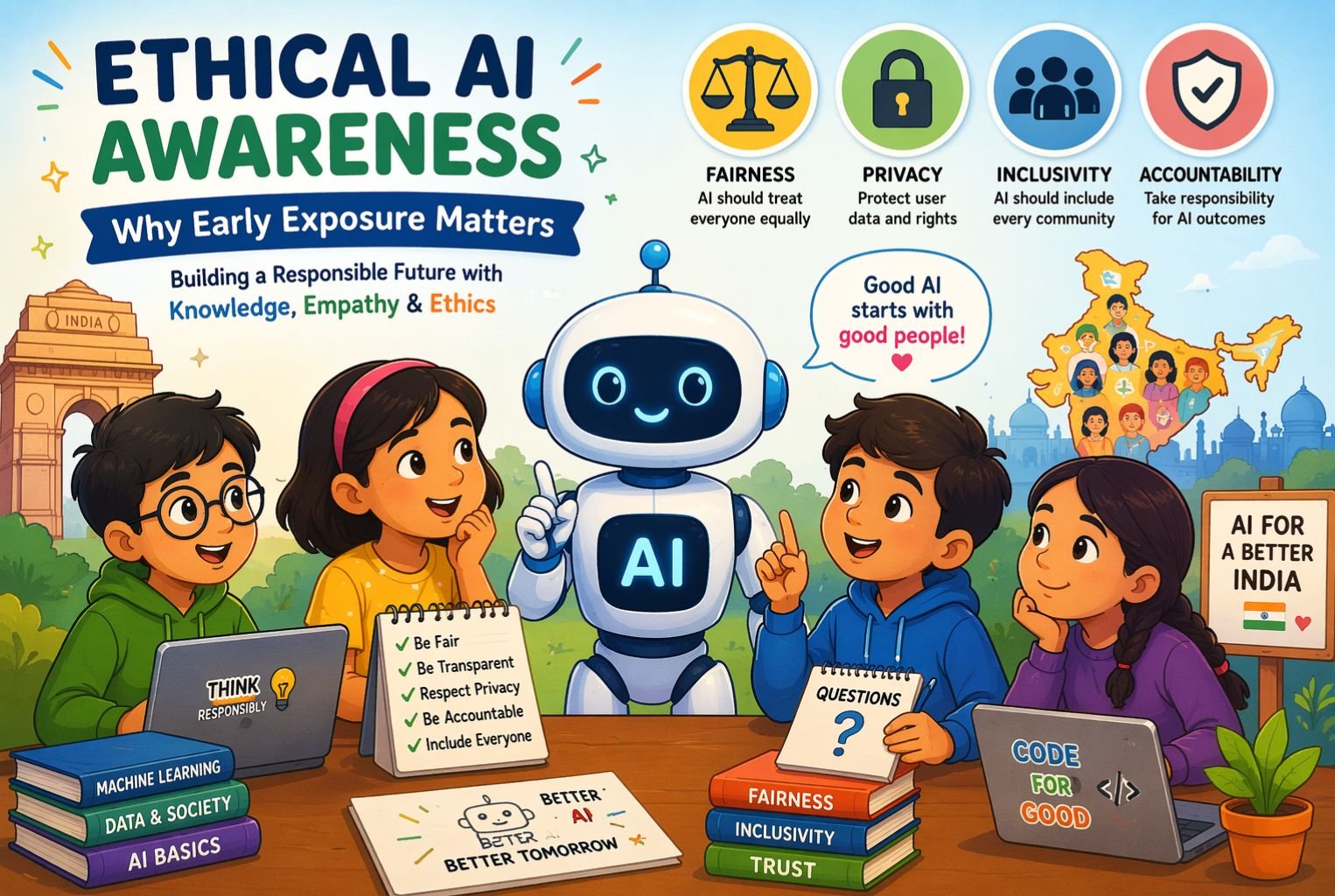
Artificial intelligence is no longer the future. It is the present. And the learners who build strong habits around AI and machine learning basics for risers in India early are the same ones who go on to make responsible, thoughtful decisions in tech careers. But here is the thing that most beginner courses miss: knowing how AI works is only half the job. Understanding the ethics behind it is the other half.
Right now, millions of students and young professionals across India are exploring technology. They are jumping into app projects, learning to code, and trying to figure out what their future in tech might look like. But very few are being taught to ask the harder questions: Who does this tool help? Who does it leave out? What happens when AI makes the wrong call?
This article is about why ethical AI awareness should not be an afterthought. It should be woven into the very first conversation you have about technology. If you are just starting, this is the mindset that will separate you from the crowd.
What Is Ethical AI and Why Does It Matter for Beginners?
Ethical AI refers to the practice of designing, building, and deploying artificial intelligence systems in ways that are fair, transparent, and accountable. It asks questions like, "Is this algorithm biased?" Does this product respect user privacy? Is the data being used responsibly?
For a beginner, these might sound like advanced concerns. But the truth is, the earlier you learn to think this way, the better your instincts become over time. Many of the biggest controversies in tech today, from facial recognition bias to algorithmic discrimination, trace back to developers who never asked these questions during the early stages.
Think of it this way. When you learn to drive, you learn the rules of the road alongside the mechanics of the car. Ethics in AI works the same way. It is not a separate subject. It is part of understanding the full picture.
The Connection Between AI Basics and Responsible Thinking
One of the most important reasons to pair technical knowledge with ethical grounding is that AI systems reflect the people who build them. If a developer does not consider bias, the model learns bias. If a product team ignores accessibility, the app excludes people who need it most.
This is exactly why AI and machine learning basics for risers in India should go beyond syntax and algorithms. Understanding what data means, where it comes from, and who it represents is a fundamental technical skill. Not just an ethical one.
Key Questions Every Beginner Should Ask
• Where does the training data come from?
• Which communities are represented in that data?
• What are the real-world consequences if the model makes an error?
• How can the system be corrected when it causes harm?
• Who holds accountability when things go wrong?
These are not philosophical questions. They are design questions. And asking them early shapes how you build everything that follows.

Why India Is a Critical Context for AI Ethics Education
India has one of the youngest populations in the world. By 2030, the country is expected to have over 140 million people aged between 18 and 25 entering the workforce. A significant portion of them are already leaning toward careers in technology.
But India also has unique social layers that make ethical AI especially important. Caste, gender, language, and regional diversity all affect how people interact with technology. An AI system trained primarily on urban, English-speaking data will perform poorly for rural users in Tamil Nadu or Assam. These are not edge cases. They are the majority.
This is why beginners in India need more than just coding skills. They need to understand the populations their products will serve. That awareness does not come from a single lecture. It comes from building it into every learning experience from day one.
Real-World Examples That Show Why This Matters
In 2019, a study found that several commercial facial recognition systems had error rates as high as 34% for darker-skinned women compared to less than 1% for lighter-skinned men. These are real products built by real developers who likely never stopped to question their datasets.
Closer to home, several automated hiring tools used in Indian companies have shown bias toward candidates from certain educational backgrounds, largely because historical data reinforced those patterns. The result: talented individuals from tier-2 or tier-3 cities get screened out before a human even looks at their resume.
These examples are not meant to scare anyone away from tech. They are meant to make one thing clear: the skills that prevent these problems start in the beginner phase, not after a decade of experience.
Bhubaneswar can now access the same quality of content as someone studying in Bengaluru or Mumbai. AI courses for beginners online in India have made this possible at a scale we could not have imagined ten years ago.
But access alone is not enough. The curriculum matters. A well-designed beginner course should introduce students to real-world use cases where AI decisions have social consequences. It should encourage critical thinking about data sources. It should normalize the habit of questioning what a model cannot do, not just celebrating what it can.
What to Look for in an Ethical AI-Aware Learning Path
• Case study integration: Courses that use real incidents to teach lessons.
• Diverse data examples: Training materials that represent varied demographics.
• Accountability discussions: Modules that cover who is responsible when AI fails.
• Project-based learning: Assignments that require students to evaluate bias in their own models.
• Community exposure: Interaction with peers from different regions and backgrounds.
The best ai courses for beginners online in India are the ones that treat ethics as a core skill, not a bonus module tucked in at the end.
App Development and the Ethics of What You Build
Building an app is not just a technical exercise. Every app collects data. Every app makes decisions. And every app affects real people in ways that its creators may not immediately see.
For anyone getting into app development for beginners online, the entry point often looks like tutorials and templates. And that is completely fine as a starting point. But at some stage, every beginner needs to confront the question: What does my app do when something goes wrong?
Think about a student building a simple recommendation app for local restaurants in their city. Who does it recommend? Are vegetarian options prioritized fairly? Does it account for neighborhoods that may have fewer restaurant listings because of fewer internet users? These are not complex questions. But they are important ones.

Ethical Considerations When Building Your First App
• What data does your app collect, and does the user know about it?
• Is your app accessible to people with disabilities?
• How does your app behave when the data is incomplete or incorrect?
• What happens to user data if the app is taken down?
• Are there any communities your app unintentionally ignores?
Those learning app development for beginners online in India would benefit enormously from having these questions built into their first project brief. Not as extra work, but as a natural part of the design process.
Building a Culture of Responsibility from Day One
Here is something that often gets lost in the rush to learn the latest tools: culture is built gradually. The habits you form in the first few months of learning become the defaults you carry through your entire career.
A developer who spent their early months asking "who might this hurt?" before shipping a feature will keep doing that at age 35 in a senior role. A developer who was never asked that question may never naturally think to ask it.
This is why early exposure is not a nice idea. It is a strategic investment in the kind of tech ecosystem India builds for the next generation. And it is why the responsibility falls not just on learners but also on educators, course creators, and platform builders.
Practical Steps for Beginners to Start Thinking Ethically About AI
You do not need to wait until you are an expert to start thinking about AI ethics. Here are some grounded, practical starting points for any beginner:
• Read one case study per week about an AI failure or controversy. It builds the habit of thinking critically about real outcomes.
• When working on any project, write down three groups of people your project might affect. Think about whether each group benefits equally.
• Learn about data sources. Before using any dataset, ask where it came from and who is represented in it.
• Join conversations. Online forums, student communities, and tech groups in India often have discussions on AI and society. Listening to diverse perspectives is itself a form of education.
• Ask questions in courses. If your instructor presents an AI model, ask about its limitations. Good educators welcome those questions.
None of these requires advanced skills. They require curiosity and the willingness to look at technology as something that exists inside society, not apart from it.
Conclusion
Ethical AI awareness is not a subject for experts. It is a mindset for anyone who wants to build technology that genuinely helps people. The earlier that mindset is planted, the more naturally it grows. Understanding AI and machine learning basics for risers in India is a great first step, but pairing that knowledge with ethical grounding is what turns a beginner into someone who builds technology worth trusting.
Whether you are exploring app development for beginners online in India or diving into your first machine learning project, make the habit of asking who benefits and who does not. Make it part of your process from day one. Platforms like Rise With Tech are actively building learning paths that reflect this philosophy because they know that responsible developers are not born, they are shaped by the right environment.
FAQ:
1. What is ethical AI and why should beginners learn it?
Ethical AI focuses on fairness, transparency, and accountability. Learning it early helps avoid bias and harmful outcomes.
2. How are AI basics connected to ethical thinking?
Every technical decision impacts real users. Ethical learning helps understand these social consequences.
3. Are there beginner AI courses in India that include ethics?
Yes, many courses include ethics, bias, and real-world case studies. Choose ones with ethics in the core curriculum.
4. How does app development relate to AI ethics?
Apps affect user data, privacy, and accessibility. Ethical thinking ensures responsible and inclusive design.
5. What is a simple ethical habit for beginners?
Consider different user groups before building. Ensure your solution treats all users fairly.