Most conversations around AI courses for beginners online in India are aimed at teenagers and adults. But what if we started much, much earlier? What if a five-year-old could begin building the foundations of logical thinking, pattern recognition, and cause-and-effect reasoning long before they ever touched a coding platform or signed up for a course?
This isn’t a new or radical idea. For many years, early childhood experts have understood that the way children think and learn between the ages of three and seven can shape their abilities for life. Introducing AI thinking at this stage doesn’t mean giving kids screens or devices. Instead, it’s about nurturing the right kind of thinking through simple, everyday activities like play, storytelling, sorting games, and meaningful conversations.
If you’re a parent, teacher, or someone who spends time with young children, this is for you. The aim is straightforward: to help you introduce the basic ideas behind artificial intelligence in a natural, screen-free way that fits easily into a child’s daily life.
Why Start AI Thinking Before Formal Education?
Children are naturally curious and love to find patterns in the world around them. If you watch a five-year-old sorting toys by color, size, or shape, they’re already practicing basic classification. When they try to guess what comes next in a sequence, they’re using prediction skills. These simple activities may look like play, but they reflect the same core ideas used in machine learning.
Between the ages of three and seven, a child’s brain develops rapidly. During this stage, it forms connections faster than at any other time in life. Introducing concepts like logical thinking, “if-then” reasoning, and decision-making during these years helps build strong thinking habits that stay with them as they grow.
Research supports this approach. A 2023 study by the National Institute for Early Education Research found that children who took part in structured logic and sequencing activities before the age of six showed better problem-solving skills by the time they were ten. These abilities are closely linked to success in technical and analytical fields later on.
What AI Concepts Can a Five-Year-Old Actually Understand?
The instinct when people hear "AI for kids" is to think of robots, voice assistants, or complicated computer programs. Strip all of that away, and what you are left with is a handful of ideas that are entirely accessible to young children.
Classification
This is the ability to group things based on shared features. A child who sorts blocks by color or animals by whether they have legs or not is already classifying. Machine learning systems do exactly this, just at an enormous scale. You can build this skill through sorting games, scavenger hunts, and simple storytelling where characters are grouped by traits.
If-Then Reasoning
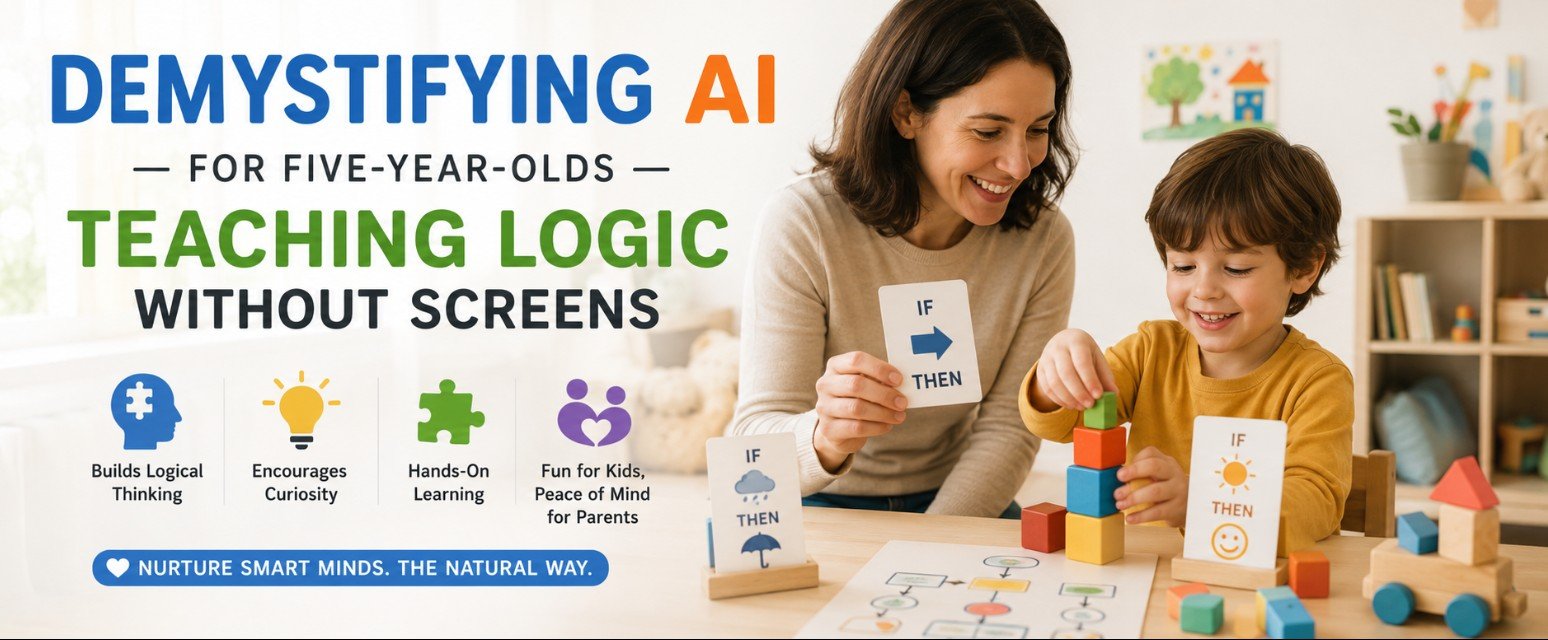
If it is raining, we carry an umbrella. If the light is red, we stop. Children already use this logic instinctively. Making it explicit by naming it and practicing it through simple games builds a foundation that directly maps onto how algorithms function. Try asking your child, "If the bear is hungry, what does it do? What if it is full?"
Sequences and Order
Algorithms are instructions in a specific order. Teaching a child to follow a recipe, draw step-by-step instructions for making a sandwich, or put story cards in the right sequence is teaching them that order matters and that changing the order changes the result.
Recognising Patterns
Show a child the pattern red-blue-red-blue and ask what comes next. This is a prediction, one of the central tasks of machine learning. Simple pattern activities build the intuition that the world often follows rules and that spotting those rules gives you an advantage.
Screen-Free Activities That Teach AI Thinking

You do not need any technology to teach the ideas behind artificial intelligence. In fact, starting without screens has a distinct advantage: it forces children to engage physically and verbally, which deepens understanding.
The Sorting Bowl
Gather a collection of household items, buttons, bottle caps, leaves, and pasta shapes and ask your child to sort them any way they like. Then ask them to sort them a different way. This mirrors how classification algorithms can be retrained with different criteria. There is no single right answer, just different useful groupings.
The Robot Game
One person plays the robot and can only follow the exact instructions. The other person gives instructions to get the robot from one side of the room to another. If the instruction is "walk forward," the robot walks forward until told to stop. This teaches children that computers cannot guess intent. They follow only what they are told, precisely.
Story Branching
Tell a story and pause at decision points. "The rabbit sees two paths. One goes through the forest and one goes through the meadow. If the rabbit is afraid of wolves, which path does it choose?" Branch the story based on different character traits. This is decision tree thinking made accessible to a five-year-old.
The Yes/No Sorting Game
Pick a mystery object and let the child ask only yes/no questions to figure out what it is. This mirrors binary search and logical elimination, two concepts that appear throughout computer science. Twenty questions is not just a party game. It is a lesson in structured reasoning.
• Sorting games build classification skills.
• The robot game teaches precise instruction-giving.
• Story branching introduces decision trees.
• Yes/no guessing games build logical elimination.
• Pattern activities develop prediction skills.
How Parents and Teachers Can Structure This Learning
Structure matters more than frequency. A child who does one focused logic activity three times a week will build stronger habits than one who does scattered activities every day without intention. Here is a simple framework that works for both home and classroom settings.
• Monday: A pattern activity. Sequences with objects, drawings, or sounds.
• Wednesday: A sorting or classification game with everyday items.
• Friday: A story or role-play activity involving decisions and consequences.
Each session needs to be short. Ten to fifteen minutes is enough for a five-year-old. The goal is not coverage. It is consistency. Children at this age learn through repetition and slight variation, not through cramming.
Teachers can also integrate these ideas across subjects. A science lesson about animals can include classification by habitat. A math lesson on patterns sets up prediction. A language arts lesson can involve story sequencing. AI thinking does not need its own subject. It belongs inside every subject.
Rise with Tech takes this integrative approach seriously, recognizing that building a future-ready learner starts well before they open a browser or write their first line of code.
Bridging Early Learning to Formal Tech Education
At some point, children who have grown up with strong logical thinking foundations will be ready for formal introductions to technology. This might mean learning to build simple interactive pages when they learn HTML for beginners online or exploring how algorithms work through visual block coding environments.
The transition from screen-free logic games to digital environments is much smoother for children who have already internalized the underlying concepts. A child who has spent years practicing if-then reasoning will find coding logic intuitive rather than alien. A child who has sorted and classified will understand variables and data types quickly.
This is also why encouraging young learners to eventually explore AI courses for beginners online in India is a natural next step, not a leap. The foundation laid in early childhood creates momentum. Formal courses become the language for ideas the child already understands.
And as they grow, the same learner who started with sorting bowls might explore AI and machine learning basics for risers in India and connect those early intuitions to real systems, real data, and real careers.
What to Avoid When Teaching AI Concepts to Young Children
A few common mistakes can slow down the process or create confusion.
• Avoid introducing too many concepts at once. One idea per session is enough.
• Do not use the word "AI" as a buzzword without grounding it in something concrete the child has just experienced.
• Avoid making it feel like formal schoolwork. If it feels like a test, the natural curiosity shuts down.
• Do not rush to digital tools. Screen-free learning at this age is more effective because it involves more sensory engagement.
• Avoid correcting pattern predictions harshly. The goal is to build reasoning confidence, not to get the right answers.
The single most important thing is keeping it joyful. AI thinking taught through play is AI thinking that sticks. The moment it becomes a performance or a competition, you lose the most valuable part of early education: intrinsic curiosity.
Teaching Children to Ask Better Questions
If there is one meta-skill that connects AI literacy to everything else in life, it is the ability to ask good questions. AI systems are built by people who ask, "What do we want to predict?" What data do we have? What could go wrong?
Teaching a five-year-old to ask "why" and "what if" and "what happens when" is teaching them to think like the people who build these systems. It is not about giving them answers. It is about making them comfortable with not knowing yet and curious enough to keep exploring.
As learners also explore how to learn HTML for beginners online or pick up their first digital skills, that same question-asking habit will make them better developers, better designers, and better problem-solvers. It all starts with a child asking, "But why does the pattern change here?"
Conclusion
Teaching AI concepts to five-year-olds is not about making them into engineers before they lose their baby teeth. It is about building the mental habits that make complex thinking feel natural: sorting, sequencing, predicting, questioning, and reasoning through cause and effect.
These habits do not require screens, subscriptions, or specialized toys. They require adult attention, thoughtful conversation, and a willingness to turn everyday moments into small logic puzzles. The child who grows up doing this will walk into a classroom or onto a platform offering AI courses for beginners online in India with a running head start.
If you are looking for a structured path that connects early thinking habits to real tech skills as your child grows, Rise With Tech offers resources designed to bridge that journey at every stage, from curious beginner to confident builder.
1. Can a five-year-old understand AI concepts?
Yes, basic ideas like patterns and sorting can be learned. These build early AI thinking skills.
2. Do kids need apps to learn AI?
No, screen-free games and activities work best. They help children learn through play.
3. How does early logic connect to AI learning?
It builds skills like reasoning and prediction. These make AI concepts easier later.
4. How much time should be spent weekly?
About 10–15 minutes, 3 times a week is enough. Consistency matters more than duration.
5. When should kids start formal AI or coding courses?
Usually between ages 8–10. By then, they can better understand structured learning.